Reading a Nutrition Label Without Math Anxiety
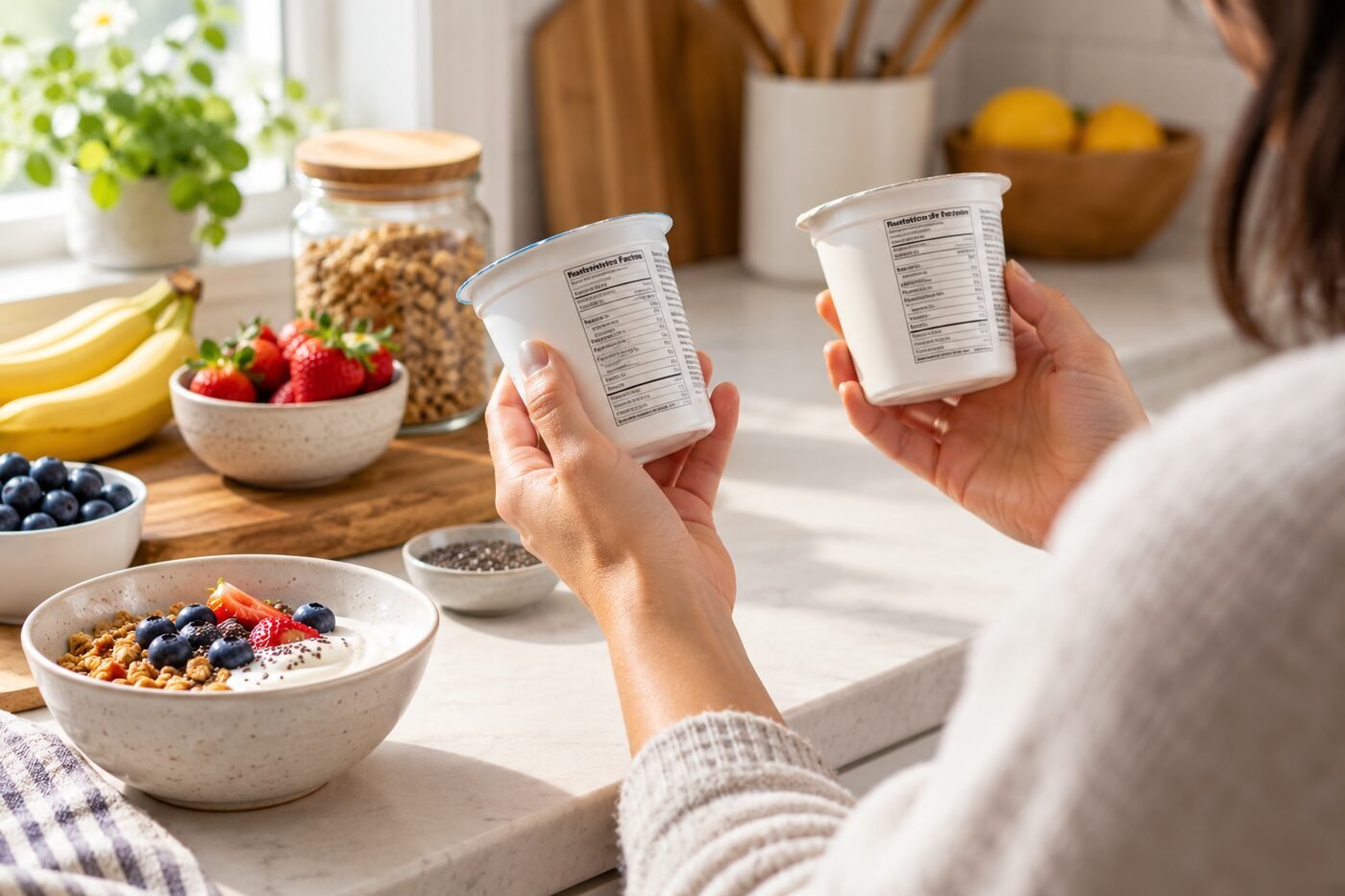
Reading a Nutrition Label Without Math Anxiety
Article 3 · Wave 1 · HowToCookEasily
Category: Nutrition · Basics | Author voice: Ellie Hart | Target length: ~6 min read
Slug: `/how-to-read-a-nutrition-label/`
Meta title: How to Read a Nutrition Label (What Actually Matters)
Meta description: A dietitian-free, math-free way to read any food label: the three numbers worth checking, the one trick most people miss, and what you can safely ignore.
You’re in the store, holding two yogurts. One says natural, one says light, both have a wall of numbers on the back, and you have about nine seconds before someone’s cart clips your elbow.
Here’s the secret nobody tells you: you don’t need to read the whole label. Three spots tell you almost everything. The rest is decoration — or worse, marketing.
This is the exact 10-second routine I use on every new package that comes into my kitchen. No calculator, no percentages-of-your-daily-what.
First, the trick that changes everything: check the serving size before anything else
Every number on a nutrition label is scaled to the serving size printed at the top — and that serving size is decided by the manufacturer, not by how much you actually eat.
Classic examples:
- A bottle of “single-serve” iced tea that lists 2.5 servings per bottle.
- Cooking spray with a serving size of ¼ second of spraying (yes, really — so it can say 0 calories).
- Cereal measured in ¾ cup, when most bowls hold closer to 2 cups.
- You want high %DV for the good stuff: fiber, protein, calcium, potassium, iron, vitamin D.
- You want low %DV for the stuff most of us already get too much of: added sugar, sodium, saturated fat.
- Total sugars includes naturally occurring sugar — the lactose in plain yogurt, the fructose in canned peaches in juice. Don’t fear those.
- Added sugars is what manufacturers put in. The American Heart Association suggests staying under about 25g/day for women, 36g/day for men, and one sweetened yogurt can burn through half of that alone.
- If sugar (or its aliases — cane syrup, dextrose, honey, fruit juice concentrate, maltodextrin…) appears in the first three ingredients, the product is mostly marketing.
- Short lists generally beat long ones. Five ingredients you recognize beats twenty you don’t.
- Front-of-pack buzzwords — natural, multigrain, made with real fruit, lightly sweetened — have no strict legal definition for most foods. They live upstairs from the real information. Read downstairs.
- Total carbohydrates as a standalone number — it lumps lentils in with lollipops. Look at fiber and added sugar instead.
- Cholesterol on most foods — dietary cholesterol matters far less than once thought for most people.
- Vitamins A and C on US labels — no longer required, because actual deficiencies are rare.
- Calories per gram conversions, exact macro ratios, “net carbs” math — unless a doctor put you on a specific plan, this is precision theater for grocery shopping.
- Servings per container → multiply before believing anything.
- %DV: ≤5% is low, ≥20% is high. High = fiber/protein/minerals. Low = added sugar/sodium/sat fat.
- Added sugars line > total sugars line, every time.
- Ingredient list, first three slots: real food or sugar in disguise?
- Ignore: total carbs, cholesterol, front-of-pack adjectives.
- Calorie & Macro Calculator — find your personal daily targets, so %DV stops being somebody else’s 2,000.
- Food Nutrition Explorer — full profiles for whole ingredients that never come with a label.
- Is It Done? Temperature Guide — because the safest ingredient is a properly cooked one.
So the very first move is always the same: find the servings-per-container number and multiply mentally. That innocent-looking 120-calorie drink is 300 calories if you finish the bottle — which you will, because it’s a drink.
The good news: since 2020, US labels are required to reflect amounts people realistically eat in one sitting, so fewer packages pull this trick than they used to. But imported goods, bulk items and drinks still do constantly. One glance at the top of the label saves you from all of them.
The 3-second rule for % Daily Value
Under every nutrient you’ll see a percentage: % Daily Value (%DV). This is the part people either obsess over or skip entirely. Here’s all you need:
| %DV | What it means |
|---|---|
| 5% or less | Low in that nutrient |
| 20% or more | High in that nutrient |
That’s it. Two thresholds, and they work in both directions:
So when comparing two breads, don’t read the claims — just run your finger down the column. Higher fiber %DV wins. Lower sodium %DV wins. Done in three seconds.
(One footnote: %DV is based on a 2,000-calorie day, which fits some people and not others. As a rough shopping compass it works fine anyway — you’re comparing foods against each other, not auditing your soul.)
The five lines worth your time — ranked
If you only check five things on any label, make it these, in this order:
1. Serving size & servings per container
Already covered above, but it bears repeating because it re-scales everything else. Do this first, always.
2. Calories (and calories from what)
The calorie number itself matters less than where it comes from. 200 calories from something with 15g protein and 5g fiber behaves completely differently in your body than 200 calories of added sugar. Which brings us to —
3. Added sugars (not “total sugars”)
This line, required on US labels since 2020/2021, is quietly the best thing that ever happened to food labels.
A pasta sauce with 12g total sugar but 0g added sugar? That’s tomatoes being tomatoes. A sauce with 11g of added sugar per half-cup? That’s dessert wearing a red sauce costume.
4. Sodium
Bread, sauces, deli meat, canned soup, “healthy” frozen meals — sodium hides in foods that don’t even taste salty. Use the %DV shortcut: if one serving is over 20% DV, that food is doing heavy lifting toward the ~2,300mg daily limit, and it better be earning its place.
Rinsing canned beans and chickpeas in a colander removes a meaningful chunk of the sodium — free upgrade, zero effort.
5. Fiber and protein — the “will this keep me full” pair
For anything that’s supposed to be a meal (bread, cereal, frozen dinners, granola bars), these two lines predict whether you’ll be hungry again in 40 minutes. As a loose rule for grain products: 3g+ fiber per serving is respectable, 5g+ is genuinely good. For a snack to earn the word “protein” on its front, I want to see at least 8–10g on the back.
The percentages come straight from FDA reference values — the full official explanation lives on the FDA Nutrition Facts Label page{: target=”_blank” rel=”noopener”}, and the World Health Organization’s healthy diet fact sheet{: target=”_blank” rel=”noopener”} puts those numbers in everyday food terms.
The ingredient list: the part the front of the package hopes you skip
Ingredients are listed by weight, heaviest first. So:
One honest caveat: a longer label isn’t automatically evil. The vitamins and minerals added back into breakfast cereals and flour have genuinely wiped out deficiency diseases. The point isn’t “chemical = bad” — it’s that the ingredient list tells you what the food is, while the front tells you what the brand wishes you thought it was.
A worked example: two granola bars, ten seconds
Bar A: 150 calories · 7g added sugar (14% DV) · 1g fiber · 2g protein · ingredients start: oats, chicory root extract, sugar…
Bar B: 160 calories · 4g added sugar (8% DV) · 4g fiber · 6g protein · ingredients start: peanuts, oats, honey…
Same shelf, same aisle, same “wholesome” photography. But B has half the added sugar, four times the fiber, triple the protein, and food-first ingredients. It costs maybe 20 cents more. That’s the entire skill — no spreadsheet required.
What you can safely ignore
Not every line deserves your attention. Guilt-free skips:
Quick reference: pin this to the fridge
Related tools on this site
Numbers make more sense with context. These do the math for you:
Ellie’s note: I keep a running list of “shelf surprises” — foods whose labels genuinely shocked me once I did the 10-second routine. Sweetened almond milk, jarred pasta sauce, and “veggie” chips currently hold the podium. Check yours. It takes less time than reading this article did.
Last updated August 2026 · Not medical advice — if you manage a condition like diabetes or hypertension, your care team’s targets override every rule of thumb here.
This article was written with AI assistance and reviewed by our editorial team. It is not medical advice.